
Creighton Waters Demands Accuracy from the Murdaugh Defense and Harpootlian Apologizes to the Judge
 James Seidel
9 min read
James Seidel
9 min read
Prosecutor Creighton Waters looks back to his legal team when discussing aspects of the retrial of Alex Murdaugh with defense attorney Dick Harpootlian, Friday, August 14, 2026, in Lexington.
Creighton Waters Demands Accuracy from the Murdaugh Defense — But Questions Remain About What Prosecutors Knew
By James Seidel | CC News Network
COLUMBIA, S.C. — South Carolina prosecutor Creighton Waters has taken the unusual step of filing a formal correction accusing an Alex Murdaugh defense counsel of making false factual statements in open court.
The filing raises a broader question: Should the same standard of absolute factual accuracy and disclosure apply to representations made by prosecutors?
On Aug. 19, the South Carolina Attorney General’s Office filed a four-page document titled Correction of Defense Counsel’s False Statement at August 14 Hearing Regarding Polygraph.
The State takes direct aim at defense attorney Dick Harpootlian’s statement that Murdaugh had passed a SLED polygraph concerning the murders of his wife, Maggie, and son Paul.
According to the State, that never happened.
The filing says Murdaugh never submitted to a SLED polygraph on any subject. It acknowledges that Murdaugh was administered an FBI polygraph in October 2023, but says that examination dealt exclusively with financial matters rather than the murders. The State says Murdaugh failed that FBI examination and that the results suggested possible countermeasures.
Waters and the Attorney General’s Office did not characterize Harpootlian’s statement as merely mistaken.
They called it “categorically false” and alleged it was made “for no other reason than an attempt to prejudice this Court and the public.”
The filing goes further, citing Rule 3.3(A) of the South Carolina Rules of Professional Conduct concerning a lawyer’s obligation not to knowingly make a false statement of fact or law to a tribunal — or fail to correct a material false statement previously made.
The State says it was “duty bound to correct” what it describes as “verifiably false factual statements.”
That is a significant standard.
And it raises questions about whether that same standard has always been applied to the prosecution’s own representations concerning the Murdaugh case.
Did SLED Investigators Really Follow Every Lead?
Waters and investigators have repeatedly defended the murder investigation and the work performed by law enforcement.
But questions remain concerning leads that appear not to have resulted in interviews with potentially relevant witnesses.
One such issue involves a source that came to the CC News Network in January 2026.
CC News has previously raised questions concerning information attributed to the Source and whether investigators ever directly interviewed them. CC News has obtained evidence establishing that the Source was never even contacted by investigators concerning that information, even after the CC News Network received an Axon link on January 12, 2026, where direct evidence was uploaded to SLED.
That distinction matters.
The absence of an interview with the Source does not, by itself, establish that investigators ignored the underlying information. Investigators could have attempted to corroborate or disprove a lead through other witnesses, records or investigative techniques.
But if the State maintains that every lead was followed, the question is straightforward:
What exactly was done with the Source’s information?
And if the Source was never interviewed, why not?
So, when Creighton Waters stood up in court and told the Judge, the State has followed up on every lead, was this true or did Waters knowingly make a false statement of fact or law to a tribunal? We reached out to the SLED agent that was sent the evidence asking for a comment and have not received any response back.
The Juror 785 Anonymous Email
An even more complicated issue concerns Juror 785, Myra Crosby, and the anonymous email that ultimately contributed to the investigation surrounding allegations that Crosby had discussed the Murdaugh case outside the courtroom.
The email was sent anonymously to trial Judge Clifton Newman and has subsequently become an important part of the controversy surrounding Crosby’s removal from the jury.
Questions have since emerged concerning the email’s author, Christine Avery, and what communications may have occurred before Avery sent it.
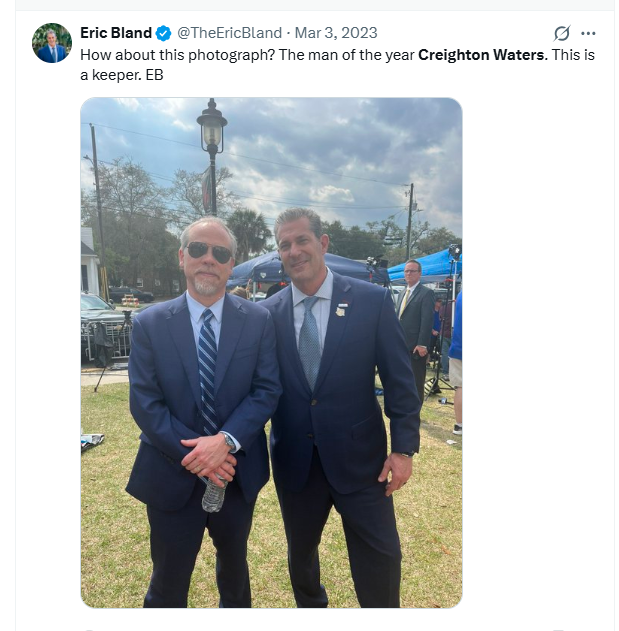
Public statements attributed to LunaShark Media concerning communications involving attorney Eric Bland and Waters have raised a potentially important timeline question:
Did Waters know about allegations concerning Juror 785 before Avery’s anonymous email reached Judge Newman? According to Lunashark Creighton Waters did know before Judge Newman received the email.
And, if so, what exactly did Waters know?
In episode #150 of True Sunlight:
The key section begins at roughly 9:50, and the sequence is explicit:
- Around 12:27, Matney says she and Liz Farrell decided to tell Eric Bland, because Bland was “in direct communication with Creighton Waters at the time.”
- Matney then says Bland contacted Waters.
- Around 13:00, she says that that night Waters asked Bland to ask Matney to ask Christine Avery for additional information and to have Avery call them.
- Matney says LunaShark instead decided it would be best to encourage Avery to contact Judge Newman directly.
- At 8:25 a.m. on Feb. 28, 2023, LunaShark’s Allie Pavlitch messaged Avery saying, in substance, that Creighton had requested more information / that she email Judge Newman.
Those questions become particularly important when compared with what was subsequently disclosed to the court concerning the anonymous email.
What did the defense know about any of this?
When Dick Harpootlian and Jim Griffin entered Newman’s chambers and the email was discussed, were they told that Waters already knew about the allegation before the email arrived? By the way, this was the same day Clerk of Court Becky Hill announced the fake Facebook post against Juror 785. This seems all too coordinated. Has the State prosecuted Hill for jury tampering? No. Why not? The South Carolina Supreme Court believed she did by a vote of 5-0 to overturn the Murdaugh conviction.
Was the defense told that Bland had communicated with Waters about the information the previous evening?
Were they told that Waters had responded through that communication chain seeking additional information from the source?
Did they know that Avery’s decision to contact Newman came only after this chain of communications involving LunaShark, Bland and the lead prosecutor?
And there is an additional question that remains unanswered: Did Waters himself ever communicate directly with Christine Avery before the email reached Newman?
This feels like the Lunashark team and Eric Bland needs to be put under oath to get to the bottom of this in front of a judge.
CC News Asked the Attorney General’s Office
These questions were not invented after Waters’ Aug. 19 filing.
On June 1, CC News Network sent the South Carolina Attorney General’s Office a detailed request for comment specifically addressing the Juror 785 timeline and alleged communications involving Waters.
Among the questions presented to the Attorney General’s Office were:
- When did Waters first become aware of allegations that Juror 785 was discussing the case outside court?
- Did Eric Bland communicate with Waters concerning Christine Avery, LunaShark or the anonymous email before the email was sent to Judge Newman?
- If those communications occurred, did Waters ask questions or relay inquiries that ultimately traveled through intermediaries back to Avery?
- Who within the Attorney General’s Office knew about the allegations before Crosby’s removal?
- Did Waters communicate with SLED concerning its investigation of Crosby’s tenants before agents appeared at their residence on Feb. 28, 2023?
- Did Waters direct, request, encourage or otherwise participate in decisions concerning that investigation?
- When Newman was informed about the anonymous email, what information concerning its source, communications or the prosecution’s prior knowledge was disclosed?
- Did Waters ever discuss, suggest, edit, draft, contribute wording to or otherwise influence the anonymous email?
Those questions were directed to Attorney General’s Office spokesman Robert Kittle and expressly requested “any response, clarification, or denial.”
The significance of those questions is greater now because of the standard Waters himself has invoked in the State’s latest filing.
What Did Waters Know — And When?
There is an important distinction that should not be lost.
Evidence that Waters spoke with Bland before Avery sent her email would not, standing alone, establish that Waters participated in writing the email, knew Avery would send it anonymously or engaged in misconduct.
Those propositions require more evidence.
But prior knowledge could become highly relevant if the prosecution subsequently participated in discussions with the trial court in which the anonymous email was treated as information arriving from an unknown or independent source without disclosure of relevant prior communications.
The precise chronology therefore matters enormously.
The relevant sequence is potentially:
allegations concerning Juror 785 → communications involving Bland and Waters → communications involving Avery → Avery’s anonymous email → SLED investigation → discussions with Judge Newman → Crosby’s removal from the jury.
Each step needs to be established through transcripts, emails, testimony, telephone records or other primary evidence.
And that is precisely why CC News sought answers from the Attorney General’s Office months before Waters filed his latest accusation against the defense.

A Standard That Applies to Both Sides
The State may ultimately have a complete explanation for each of these issues.
If so, it should provide it.
But Waters’ Aug. 19 filing makes the underlying principle difficult to avoid.
The State says lawyers appearing before a court have an obligation to make factually accurate representations. It says material inaccuracies should be corrected. And it was sufficiently concerned about Harpootlian’s polygraph statement that prosecutors filed a four-page document specifically correcting the record.
That principle should not be controversial.
Nor should its application depend upon which side of the courtroom made the statement.
If Harpootlian inaccurately told the court that Alex Murdaugh passed a SLED polygraph concerning the murders, the record should be corrected.
The State has now done exactly that.
But the same commitment to an accurate record makes unanswered questions concerning the Juror 785 episode more important — not less.
When did Creighton Waters first learn about the allegations concerning Myra Crosby?
What did Eric Bland communicate to Waters?
Did any information flow from Waters back through intermediaries to Christine Avery before she sent the anonymous email?
What did Waters tell Judge Newman about his prior knowledge or communications when the email was discussed?
And what did investigators actually do with other leads the State says were followed?
Those questions do not presume the answers.
But after the State declared itself “duty bound” to correct factual inaccuracies by defense counsel, asking whether the prosecution’s own representations withstand the same scrutiny is not an attack on the judicial process.
The State is calling out the defense for alleged inaccuracies, which they should do if in fact there were inaccuracies.
But there’s a flip side to that coin.
It is precisely the kind of scrutiny an accurate judicial record requires.
Harpootlian Apologizes
In an August 20 letter to Judge Debra McCaslin, Alex Murdaugh attorney Dick Harpootlian formally corrected a statement he made during the previous Friday’s motions hearing concerning polygraph testing. Harpootlian said he had correctly told the court that Curtis “Eddie” Smith was administered a polygraph pursuant to a proffer agreement and failed when asked whether he had killed Maggie and Paul Murdaugh — a fact Harpootlian wrote that “the State concedes is true.”
However, Harpootlian acknowledged he was incorrect when he went further and told the court that Murdaugh had been tested by the same examiner and passed “with flying colors,” explaining that he had “mistakenly conflated several facts.”
Notably, Harpootlian did not say that Murdaugh was never given a polygraph. Instead, he wrote that he was “not permitted to disclose any further details regarding any polygraph testing related to Mr. Murdaugh.” Because Judge McCaslin had already ruled that no mention of polygraph testing would be permitted at trial, Harpootlian said he assumed his mistaken statement had no effect on the court’s ruling.

Copyright 2026 CC News Network via Grayson & Mae, LLC. All rights reserved.
Over 75,000,000 Million Views on all social media
Join Our 220,000+ Followers Across all Social Media
Stay informed. Stay curious. Stay connected.
- The Murdaugh Murders X2 Podcast
- Spotify – @CrimeandCask
- X (Twitter): @CCNewsNetwork
- Our Podcast on Spotify – Swamp Justice Radio | by Crime and Cask Investigations | Podcast on Spotify
TikTok: @CrimeandCask
- YouTube: @CrimeandCask
- Rumble Videos: @Crimeandcask
Facebook: CC News Network
- Instagram: Crime and Cask (@crimeandcask) • Instagram photos and videos
- Lemon8: https://v.lemon8-app.com/s/OgchywvUf
Talk Radio: Listen Live on 97.7FM WVFF – Cottageville, SC
Amazon Author Page: James Seidel & CC News Books
Cameo: Book us @ CC News Network
Spotify: CC Records
Bluesky: @ccnewsnetwork.bsky.social
About the Author