

 James Seidel
When Everyone Is the Villain: Examining Mandy Matney and her ever Expanding Claims
By James Seidel | CC News Network
HAMPTON, S.C., — For years, former journalist turned podcaster Mandy Matney has claimed that she has been the target of a relentless campaign of harassment, bullying, intimidation, defamation, and threats.
Some of those claims involve anonymous online trolls and social media critics. Others involve Reddit groups. Others involve attorneys, lawsuits, depositions, and court proceedings.
Over time, however, a striking pattern emerges from Matney’s own public statements: the circle of alleged harassers appears to expand steadily, encompassing an increasingly broad range of people, institutions, and opponents.
The question is not whether Matney has received criticism, insults, or online abuse. Public figures often do.
The question is how many people eventually become part of the harassment narrative.
“I’ve Been Harassed Online Since 2021”
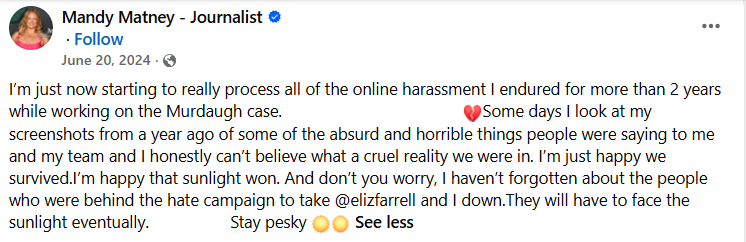
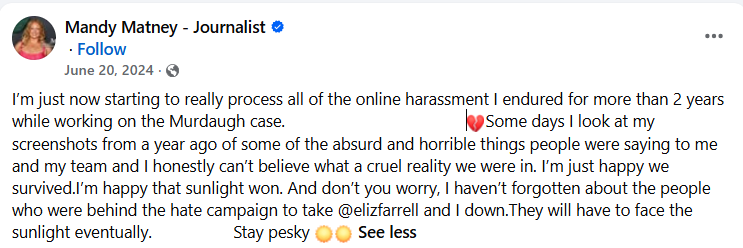
On Jan. 2, 2024, Matney told followers she had been subjected to a coordinated campaign designed to destroy both her and former journalist turned podcaster, Liz Farrell.
“I’ve been harassed online since I launched my first podcast in 2021,” Matney wrote.
“This wasn’t criticism. It was a cruel organized attack to mentally destroy @elizfarrell and me through anonymous accounts.”
She described years of attacks on her appearance, career, marriage, friends, sources, and reporting.
“They accused me of crimes and made up lies about my career.”
“They targeted my loved ones.”
“They posted about some of my closest friends.”
“They attacked my sources.”
The post went further.
Matney claimed she had identified individuals responsible for a significant portion of the alleged campaign.
“In the last week, after this bad behavior escalated, we finally figured out who was behind a main portion of the hate.”
“Two people I didn’t think were capable of that much evil, manipulation and mind games.”
Yet no names were provided.
Instead, Matney promised:
“Accountability will come another day.”
The Reddit Villains
One of Matney’s longest-running targets has been Reddit communities critical of her reporting.
On July 8, 2023, she celebrated Reddit’s ban of the LunaSnark community.
“The hate group that has harassed, bullied and made fun of my team, my family, my friends (including Sandy Smith), myself and my mental health has been BANNED FROM REDDIT.”
According to Matney, members of the group:
“Made fun of my weight, my husband, my mental health issues, my friends, and people in my life who I care about dearly.”
“They spread lies and hate against Sandy Smith.”
She called the community “horrible and cruel” and described its members as people who wanted her to disappear.
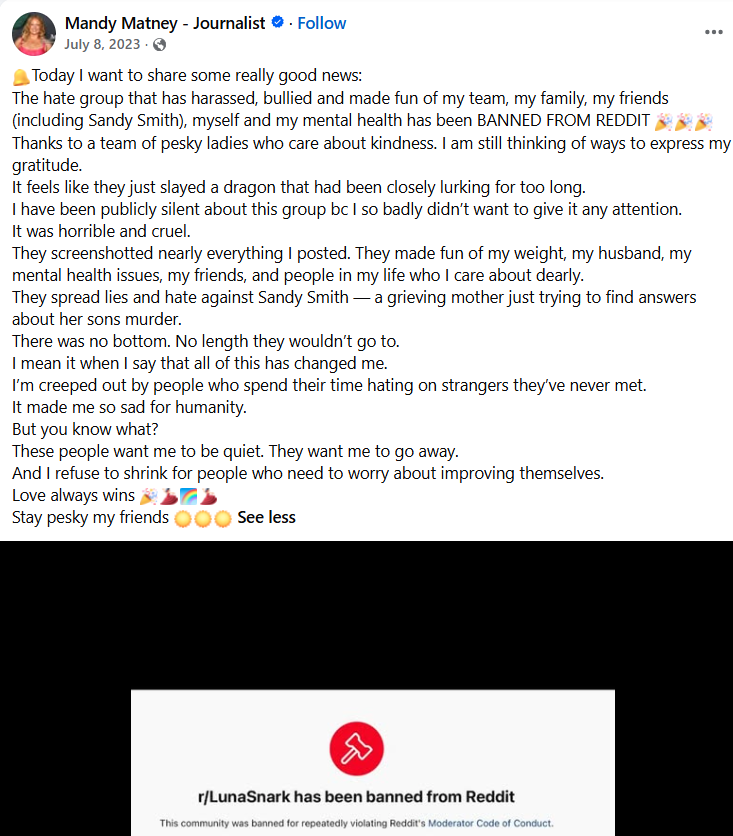
“These people want me to be quiet.”
“They want me to go away.”
Months later, she continued referencing Reddit critics as part of a broader harassment effort.
“The worst of the hatred lived on the Reddit hate group,” she wrote in January 2024.
Even after the subreddit disappeared, Matney maintained that the campaign continued through other accounts and platforms.
From Trolls to “Harassment Campaigns”
As the years progressed, Matney’s description of her critics evolved.
On March 18, she wrote:
“I still have trolls who go out of their way to defame me and harass me on the internet almost every day.”
On Sept. 25, 2023, she clarified:
“When I say ‘our trolls’ to be clear I’m referring to the people who harass us.”
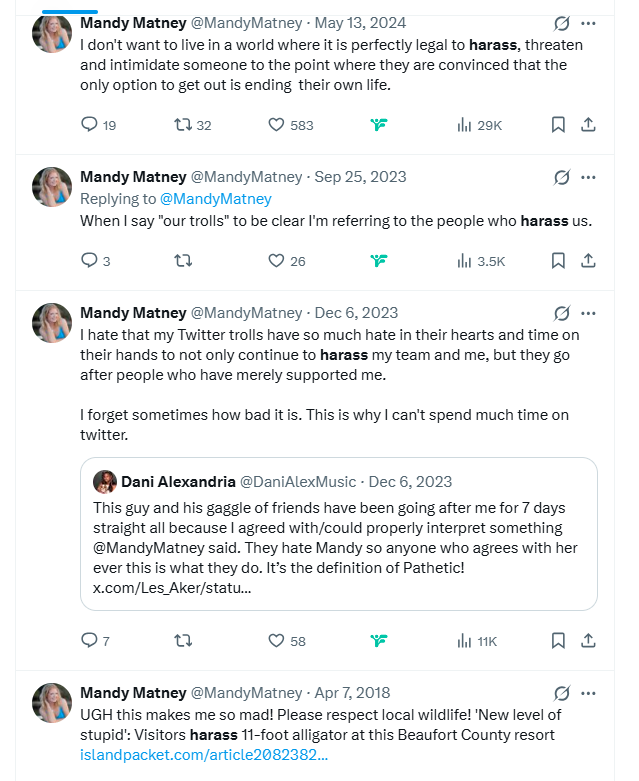
On Dec. 6, 2023, she wrote:
“I hate that my Twitter trolls have so much hate in their hearts and time on their hands to not only continue to harass my team and me, but they go after people who have merely supported me.”
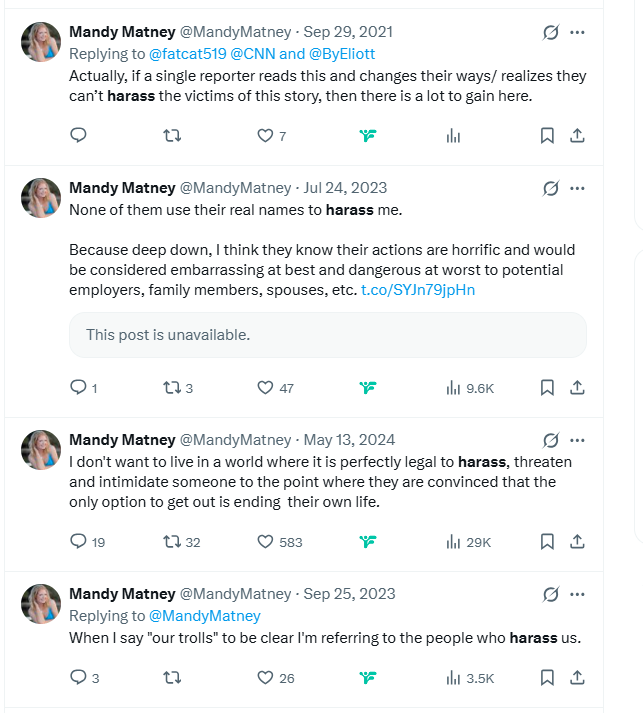
On July 24, 2023:
“None of them use their real names to harass me.”
On Oct. 18, 2023:
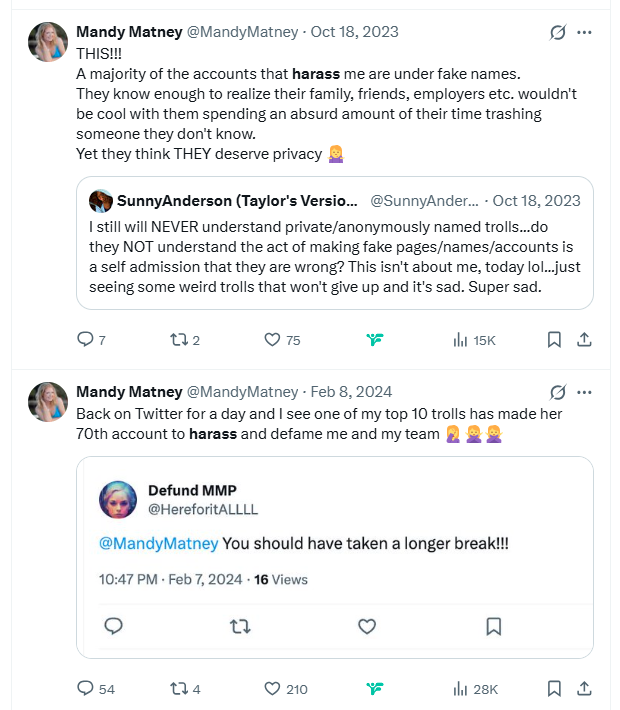
“A majority of the accounts that harass me are under fake names.”
By February 2024, Matney suggested individual critics were creating multiple social media accounts to continue attacking her.
“One of my top 10 trolls has made her 70th account to harass and defame me and my team.”
Throughout these posts, the alleged perpetrators remain largely anonymous.
The targets, however, become increasingly expansive.
The Stephen Smith Connection
The harassment narrative also became intertwined with the Stephen Smith case.
On March 20, 2023, Matney posted:
“There appears to be a behind-the-scenes effort to harass those who are seeking to get justice for Stephen Smith.”
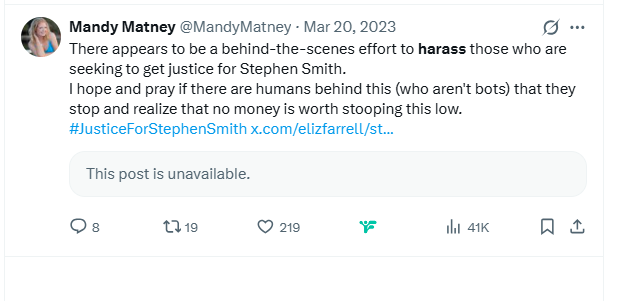
She added:
“I hope and pray if there are humans behind this (who aren’t bots) that they stop and realize that no money is worth stooping this low.”
The implication was significant.
The alleged harassment was no longer simply about Mandy Matney.
It was now being connected to people seeking justice in one of South Carolina’s most closely watched cases.
When Attorneys Become Harassers
The most dramatic expansion of Matney’s harassment narrative may involve attorneys and litigation.
In recent years, Matney has repeatedly characterized legal actions taken against her—or involving her—as forms of harassment.
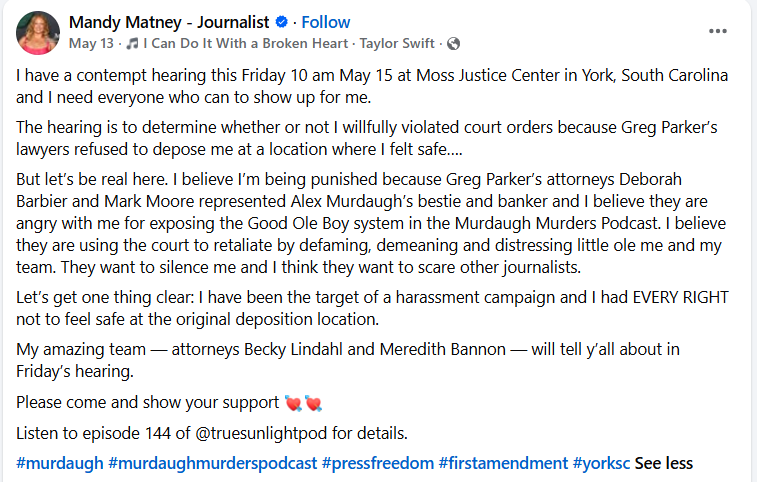
On May 13, before a contempt hearing in York County, Matney wrote:
“I believe they are using the court to retaliate by defaming, demeaning and distressing little ole me and my team.”
The “they” referenced attorneys Deborah Barbier and Mark Moore, who represent interests connected to Parker’s litigation.
She continued:
“They want to silence me and I think they want to scare other journalists.”
She later declared:
“Let’s get one thing clear: I have been the target of a harassment campaign.”
The theme appeared again in a Dec. 1, 2025 post.
“Mark Moore … is also the recipient of an absurd amount of tax dollars for doing what it appears to be NOTHING (in my opinion).”
More importantly, she accused him of:
“working overtime to harass, bully and defame Liz Farrell and me.”
The accusation was direct and personal.
It also represented a significant departure from the anonymous trolls and fake accounts she had spent years discussing.
Now, licensed attorneys engaged in litigation had become part of the same harassment framework.
Depositions as Harassment
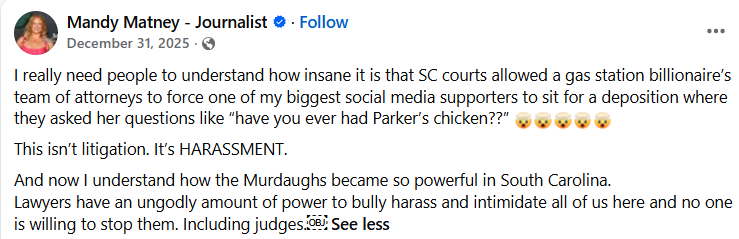
Perhaps the most revealing example came Dec. 31, 2025.
Matney criticized a deposition involving one of her supporters.
“I really need people to understand how insane it is that SC courts allowed a gas station billionaire’s team of attorneys to force one of my biggest social media supporters to sit for a deposition…”
Then she made an unequivocal statement.
“This isn’t litigation. It’s HARASSMENT.”
She followed with an even broader indictment:
“Lawyers have an ungodly amount of power to bully, harass and intimidate all of us here and no one is willing to stop them.”
Then came perhaps the most striking addition to the list.
“Including judges.”
At that point, the alleged harassers were no longer anonymous internet users.
The criticism extended to lawyers, legal teams, and members of the judiciary itself.
Bill Padgett Joins the List
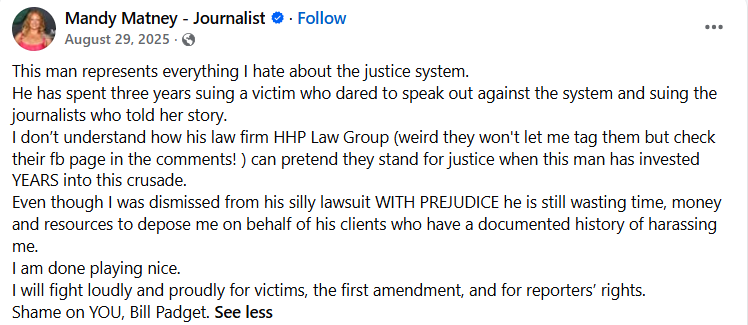
On Aug. 29, 2025, Matney turned her attention to attorney Bill Padgett.
“He has spent three years suing a victim who dared to speak out against the system and suing the journalists who told her story.”
She then claimed Padgett represented clients with:
“a documented history of harassing me.”
The accusation placed another attorney into the category of individuals allegedly participating in harassment.
Again, the line between legal advocacy and harassment appeared blurred.
The Expanding Circle
Reviewing years of public statements reveals a notable evolution.
The original alleged harassers were anonymous internet users.
Then came Reddit groups.
Then social media critics.
Then unnamed journalists.
Then podcast critics.
Then supporters of opposing viewpoints.
Then attorneys.
Then law firms.
Then legal teams.
Then litigants.
Then court proceedings.
Then depositions.
Then judges.
Throughout this period, Matney has consistently framed herself as the target of a broad and coordinated campaign.
What has changed is the number of people who appear to be included within that framework.
The Question
None of this proves that Matney was never harassed.
To the contrary, many of the comments she has shared publicly are ugly, personal, and often cruel.
But her own statements raise a different question.
At what point does a harassment narrative become so expansive that criticism, disagreement, litigation, adverse testimony, legal process, opposing counsel, social media commentary, and judicial rulings are all viewed through the same lens?
That question may ultimately be more significant than the trolls themselves.
Because when nearly every opponent becomes a harasser, every critic becomes a bully, every deposition becomes intimidation, and every adverse legal action becomes retaliation, the story is no longer just about harassment.
It becomes a story about where the line between harassment and disagreement is drawn—and who gets to draw it.
The Timeline of a Deposition Nobody Could Stop
October 2025: “You Can’t Depose Me”
The first defense was legal.
When Parker’s attorneys subpoenaed Mandy Matney, the fight centered on reporter’s privilege and shield-law protections. The argument was straightforward: she was a journalist, not a party to the lawsuit, and Parker should not be allowed to force her testimony or obtain protected materials.
November–December 2025: “The Deposition Is Too Burdensome”
When the Court did not immediately grant the relief she sought, the emphasis shifted.
The filings began focusing on:
- Luna Shark business obligations,
- podcast production schedules,
- television-related commitments,
- financial burden,
- disruption to her company.
January–February 2026: “My Schedule Doesn’t Allow It”
As the litigation moved forward, scheduling issues became a recurring theme.
The filings highlighted:
- travel commitments,
- work obligations,
- promotional appearances,
- media projects.
February 2026: The Court Says No
The first major legal setback arrived when Judge Keith Kelly denied the Motion to Quash.
The deposition was not going away.
Matney then sought reconsideration.
That was denied as well.
March 2026: The Excuses Narrow
After losing both the Motion to Quash and the Motion to Reconsider, something changed.
The earlier arguments began disappearing.
Reporter’s privilege was no longer the central issue.
Scheduling was no longer the central issue.
Business burden was no longer the central issue.
Instead, nearly everything began revolving around a single concept:
Harassment.
Mid-March 2026: Harassment Becomes the Primary Narrative
This is where the filings begin repeatedly referencing:
- online criticism,
- social media posts,
- memes,
- articles,
- TikToks,
- Crime and Cask,
- James P. Seidel,
- alleged online harassment.
The focus was no longer:
“I should not be deposed.”
The focus had become:
“I cannot safely be deposed.”
The distinction matters.
One is a legal argument.
The other is an emotional and factual argument.
March 16, 2026: Judge Kelly Orders the Deposition
Then came the order that changed everything.
Judge Kelly ordered Matney to sit for a deposition within fourteen days.
From that point forward, the debate was no longer whether she would be deposed.
The Court had already decided that question.
March 20–27, 2026: The Goalposts Move Again
Once the Court ordered the deposition, the battle shifted again.
Now the argument became location.
The filings began focusing on:
- security concerns,
- unsafe conditions,
- fear of harassment,
- fear of confrontation,
- demands for alternate locations,
- demands for additional protections.
March 16, 2026: Judge Kelly Orders the Deposition
Then came the order that changed everything.
Judge Kelly ordered Matney to sit for a deposition within fourteen days.
From that point forward, the debate was no longer whether she would be deposed.
The Court had already decided that question.
March 20–27, 2026: The Goalposts Move Again
Once the Court ordered the deposition, the battle shifted again.
Now the argument became location.
The filings began focusing on:
- security concerns,
- unsafe conditions,
- fear of harassment,
- fear of confrontation,
- demands for alternate locations,
- demands for additional protections.
The question was no longer:
“Can Parker depose Mandy Matney?”
The question became:
“Where can Parker depose Mandy Matney?”
That distinction is critical.
Because it demonstrates how the scope of the dispute narrowed every time a prior argument failed.
The Fatal Admission
Then came the testimony.
Under oath, Matney made several admissions that undermined months of filings.
She admitted:
- the original affidavit did not rely on safety concerns;
- she knew the Motion to Quash had been denied;
- she knew reconsideration had been denied;
- she knew the Court ordered the deposition;
- she knew no stay had been entered.
Most importantly, she admitted she made the decision not to go to the noticed deposition location.
That admission effectively eliminated confusion as a defense.
The Harassment Narrative Begins to Crumble
The most revealing part of the testimony involved the alleged danger itself.
When repeatedly asked what specific threat existed at the deposition location, Matney struggled to identify one.
Instead, the testimony relied heavily on:
- feelings,
- fears,
- interpretations,
- concerns about what might happen.
The problem was obvious.
The motions often suggested imminent danger.
The testimony frequently described subjective fear.
Those are not the same thing.
After Refusing to Appear
The contradiction became even sharper after the missed deposition.
According to testimony and exhibits, Matney:
- traveled publicly,
- appeared publicly,
- posted publicly,
- socialized publicly,
- celebrated publicly.
Parker’s attorneys repeatedly highlighted this discrepancy.
If the threat was truly immediate and severe, why was the only place she could not safely appear the location identified in the subpoena?
April 2026: The Court Cuts Through the Noise
By the time Judge Kelly ruled on the Rule to Show Cause, months of arguments had been reduced to a simple question:
Did Mandy Matney comply with the subpoena and court order?
The Court found she did not.

About the Author


