

Inside the Murdaugh Media Pipeline: Depositions, Leaks, Lawsuits and a Dumpster Fire
 James Seidel
Table of Contents
ToggleInside the Murdaugh Media Pipeline: Sworn Deposition Raises New Questions About Confidential Discovery, and the Attorney General’s Office Allegedly Feeding a News Organization the Complete Murdaugh Dossier.
By James Seidel | CC News Network | Crime and Cask Investigations
HAMPTON COUNTY, S.C., — A sworn deposition filed in Hampton County may have opened one of the most significant unresolved questions yet in the sprawling universe surrounding the Alex Murdaugh investigations, the Parker’s boat crash litigation, and the journalists who helped shape national coverage of both.
The issue is no longer merely whether alleged confidential materials were leaked in the Beach v. Parker 392 case. Because they were leaked.
The real question now may be:
How did non-party media figures allegedly obtain confidential discovery materials governed by a court confidentiality order in the first place?
And perhaps even more importantly:
Did investigative materials connected to the Murdaugh case move from government or litigation channels directly into the hands of media organizations covering the story?
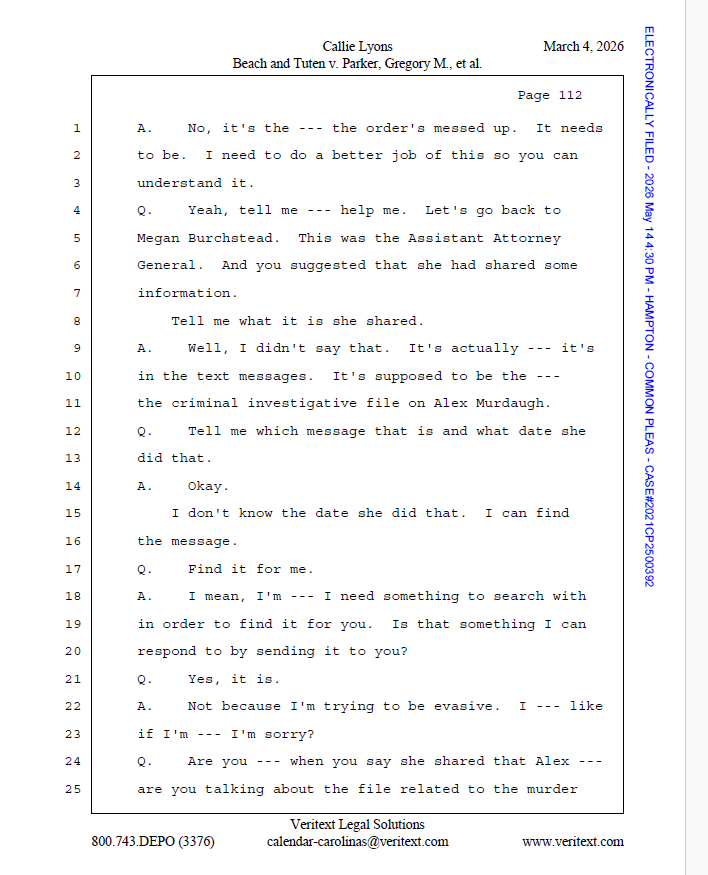
Those questions exploded into public view during the March 4, 2026 videotaped deposition of Callie Lyons in the Hampton County case of Beach v. Parker.
Lyons, a former contractor for LunaShark Media and later a researcher and journalist for FITSNews, testified under oath about thousands of text messages and communications she said appeared on her devices through what she described as a shared FITSNews iCloud environment.
What emerged from that testimony may become one of the most explosive discovery controversies yet tied to the Murdaugh media ecosystem.
Buckle up, as we’re the only media outlet covering this exclusive and explosive new evidence in the Beach v Parker 392 case, and the Murdaugh trial saga.
The Confidentiality Order
The backdrop to the deposition is a formal confidentiality order entered in the Parker litigation by Judge R. Keith Kelly under Rule 26(c) of the South Carolina Rules of Civil Procedure.
The order explicitly restricts dissemination of confidential discovery materials to narrowly defined categories of individuals, including:
- attorneys,
- parties,
- litigation staff,
- investigators,
- consultants,
- experts,
- and persons specifically authorized by the court.
The order further states:
“Documents designated CONFIDENTIAL under this Order shall not be used or disclosed… for any purposes whatsoever other than preparing for and conducting the litigation…”
It also requires parties filing confidential material with the court to utilize protective measures such as:
- redactions,
- in camera review,
- or motions to seal.
That framework now creates a difficult and unavoidable question:
If Mandy Matney Was Not a Party to the Litigation, How Did She Obtain Confidential Discovery?
That question has become increasingly important because confidential litigation materials later appeared in public filings tied to motions surrounding Mandy Matney’s refusal to appear for a court-ordered deposition.
Parker’s defendants have reportedly stated in court proceedings that they did not disseminate the materials.
Yet confidential discovery surfaced publicly anyway.
The contradiction is now impossible to ignore.
If Parker’s did not release the material, then who did?
And how did a non-party media figure come into possession of protected litigation documents governed by a confidentiality order signed by the Judge?
Those questions now sit at the center of ongoing show-cause proceedings after Matney failed to appear for a court-ordered deposition in the Beach v. Parker litigation.
The issue is no longer simply whether journalists reported aggressively on the Beach v. Parker story.
The issue now is:
- who possessed confidential materials,
- how those materials moved,
- whether confidentiality restrictions were violated,
- and whether media organizations operated inside the same information channels as prosecutors, litigants, and investigators.
The Lyons Deposition
Lyons’ deposition may provide the clearest sworn glimpse yet into that ecosystem.
During questioning, Lyons testified she worked for LunaShark Media from approximately October 2022 until July 2023 before later moving to FITSNews.
She testified she eventually searched multiple devices in response to subpoenas in the Parker litigation and discovered what she described as thousands of communications synced through a FITSNews Apple iCloud account.
According to Lyons:
- she searched five devices,
- reviewed more than 9,000 screenshots and communications,
- and ultimately produced 161 files containing approximately 1,990 responsive text messages.
She further testified that the messages were not intentionally acquired and were not stolen.
Instead, Lyons said the materials appeared because of what she described as a shared FITSNews iCloud situation that continued syncing older communications onto her personal devices.
She testified:
“They had always been there.”
According to Lyons, many of the messages appeared connected to FITSNews journalist Jenn Wood rather than Lyons herself.
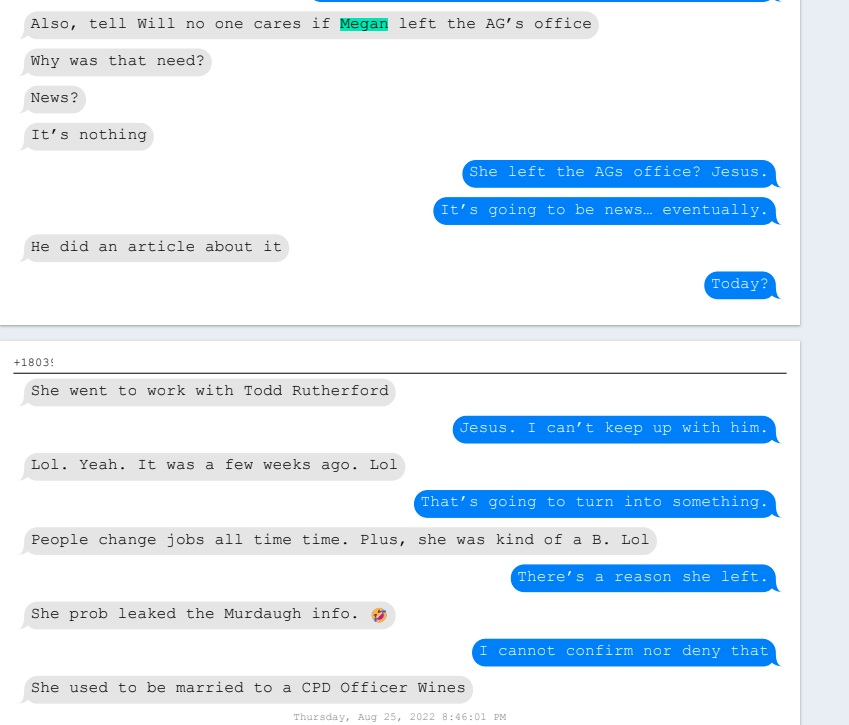
The “Murdaugh Dossier” Fallout from the Lyons Deposition Now Involves Leaked Materials from the AG’s Office to a Media Outlet
The deposition became even more significant when questioning turned toward references to what was described as a “Murdaugh dossier.”
According to testimony discussed during the deposition, certain messages referenced the South Carolina Attorney General’s Office as the source of Murdaugh-related investigative materials.
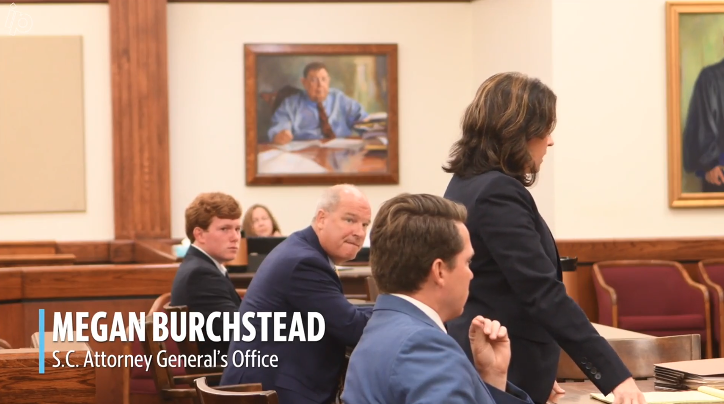
The deposition also referenced an attorney formerly with the Attorney General’s office Megan Burchstead in connection with discussions surrounding those materials.

That overlap matters because Burchstead was not simply a background prosecutor in South Carolina’s Murdaugh-related legal battles.
Burchstead served as the lead prosecutor for the South Carolina Attorney General’s Office in the criminal prosecution of Paul Murdaugh arising from the fatal 2019 boat crash that killed Mallory Beach.
She was therefore deeply involved in one of the highest-profile criminal cases connected to the broader Murdaugh saga long before the double homicide her involvement in the Alex Murdaugh trial.
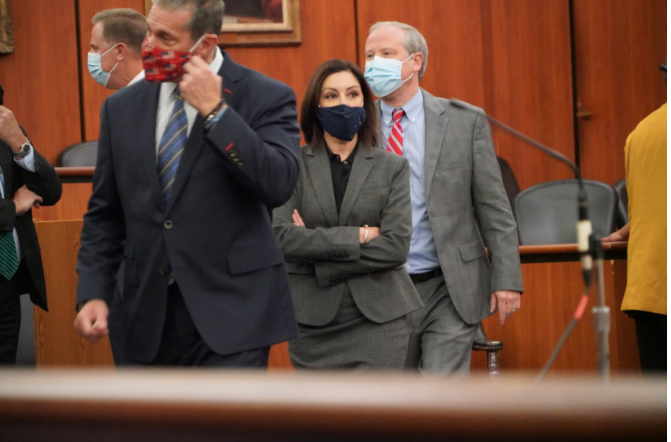
Burchstead was also later involved alongside SLED agent David Owen in the prosecution of Michael Colucci, and they teamed up again in the Alex Murdaugh case.
The Colucci prosecution ultimately collapsed when Circuit Court Judge Roger M. Young dismissed all charges in the death of Sara Moore-Colucci without prejudice, ruling prosecutors would need to return to a grand jury if they wished to pursue the case again. The Judge did this because he apparently concluded there was a fundamental problem with how the charges got there in the first place—not merely a small fixable trial issue. Meaning, David Owen withheld possible exculpatory evidence and the prosecution allegedly knew this and never handed it over to the defense.
The overlap creates an uncomfortable—but important—question.
If Murdaugh investigative materials were circulating among journalists, litigants, media organizations, and private parties before becoming publicly available, an obvious question emerges: what role, if any, did government channels play in that process?
Text messages reviewed appear to suggest that individuals connected to the investigation, media, and outside parties may have had access to investigative materials long before portions became public. However, key questions remain unanswered.
Who first possessed the materials? Were they publicly obtainable records, protected investigative files, discovery materials, or something else entirely? Who had authorized access? And perhaps most importantly: how did these materials move from investigative channels into broader circulation?
The issue is not merely whether reporters obtained information—that is common in high-profile cases. The larger question is whether government actors, directly or indirectly, contributed to the dissemination of materials that were not otherwise publicly available.
If investigative materials were indeed moving through informal channels before public release, establishing the timeline of possession, access, transmission, and disclosure becomes critical to understanding whether this was routine information sharing, unauthorized disclosure, independent acquisition, or something more significant.
The Lyons deposition itself does not prove prosecutors leaked materials, even though she worked at both media outlets, and saw firsthand what she said happened in her sworn deposition.
But it does place under oath a series of questions involving:
- prosecutors,
- investigators,
- journalists,
- confidential litigation materials,
- and the movement of information surrounding some of South Carolina’s most scrutinized criminal cases, Michael Colucci, Alex Murdaugh and now the Beach v. Parker case.

The Colucci prosecution later collapsed in a big way.
Circuit Court Judge Roger M. Young dismissed all charges against Michael Colucci in the 2015 death of his wife, Sara Moore-Colucci.
The dismissal was entered without prejudice, meaning prosecutors could theoretically refile the case — but only if they returned to a grand jury with the full body of evidence.
The case became one of the most damaging public rebukes involving prosecutorial and investigative handling tied to David Owen, whose credibility later became a major issue during the Alex Murdaugh murder trial.
Owen drew intense scrutiny over disputed testimony involving the now-infamous “high velocity impact spatter” T-shirt evidence presented to the Murdaugh grand jury and later challenged during trial proceedings.
Now, the Lyons deposition appears to place another uncomfortable issue into public view:
whether sensitive Murdaugh investigative materials may have moved from government or litigation channels directly into media hands long before the public ever saw them.
A Growing Pattern of Overlap
The Lyons deposition paints a picture of an unusually interconnected ecosystem involving:
- prosecutors,
- investigators,
- journalists,
- confidential litigation materials,
- media companies,
- Netflix discussions,
- and alleged “mock jury” conversations.
Critics of Parker’s investigators and attorneys have long argued that media pressure campaigns and leaks were weaponized during the Murdaugh-related litigation battles.
But the Lyons testimony introduces another possibility:
that some members of the Murdaugh media ecosystem may themselves have benefited from insider access to confidential or protected information.
That distinction matters.
Because the issue is no longer merely about aggressive journalism.
The issue is whether confidential litigation materials and investigative information were selectively moving between:
- government offices,
- private litigants,
- investigators,
- and media organizations.
The Matney Show-Cause Proceedings
The controversy surrounding Matney’s refusal to appear for a court-ordered deposition has now elevated those questions beyond online disputes and social media accusations.
The show-cause proceedings are important because a South Carolina judge has escalated a high-profile discovery dispute involving podcaster, and former HULU producer Mandy Matney, ordering her to appear in court and explain why she should not be held in contempt after failing to comply with a subpoena and direct court order.
Matney has advanced multiple and evolving arguments for why she should not be deposed in the Beach v. Parker litigation. Since last fall, those arguments have shifted significantly over time and have included:
• Reporter and journalism-related objections
• Claims that the deposition was unnecessary or overly burdensome
• Procedural objections regarding subpoenas and discovery
• Timing and scheduling objections
• Objections to the location of the deposition
• Allegations related to harassment and stalking concerns
• Assertions involving personal safety concerns, even though the judge denied her motion saying, “The motion does not present any evidence that would warrant relief sought by Ms. Matney.”
Critics of Matney’s position argue that the changing nature of these objections raises questions about whether the issue was the deposition itself—or simply avoiding it altogether.
Matney’s numerous motions with differing opposition to deposition evolved into something even more unusual when she filed a motion containing hundreds of pages of exhibits—including the Callie Lyons deposition itself—while simultaneously arguing that Parker’s motion for contempt and Judge Kelly’s show-cause proceedings should be denied because Parker’s allegedly failed to attach an affidavit to its motion, citing a court case from the late 1800’s.
That argument became more noteworthy after the court rejected the objection in open court—yet similar objections later reappeared in public filings that again included the Lyons deposition, multiple times.
The contradiction is difficult to ignore.
The confidentiality order itself states that confidential materials (Lyons deposition), are not to be publicly disclosed outside the litigation except under limited circumstances. Yet materials that have repeatedly been described as confidential—including the Lyons deposition—appeared in the public index anyway.
That raises questions extending far beyond a single deposition dispute.
If confidential materials were repeatedly filed publicly, who made that decision?
If Parker’s defendants maintain they were not the source of the disclosure, then how did the materials reach third parties?
And if the materials were not actually confidential, why were confidentiality arguments repeatedly invoked in the first place?
Those questions may ultimately become some of the most significant unresolved issues surrounding the flow of information among litigants, journalists, witnesses, and outside parties during the broader Murdaugh media era.
Editor’s Note: This article is derived entirely from publicly filed court documents and filings submitted by attorneys representing Mandy Matney, a non-party participant in the Beach v. Parker 392 litigation. This reporting is based on matters contained within a high-profile civil lawsuit and is presented solely for journalistic and public interest purposes. The publication of this information should not be construed as harassment, intimidation, or stalking, but rather as reporting on publicly available court proceedings and filings.

Copyright 2026 CC News Network via Grayson & Mae, LLC. All rights reserved.
Over 75,000,000 Million Views on all social media
Join Our 220,000+ Followers Across all Social Media
Stay informed. Stay curious. Stay connected.
- Swamp Justice Radio on Spotify – @CrimeandCask
Telegram News Alerts (Free – Just Click to Add Us) https://t.me/+zfTsM89U2Mo4MDlh
X (Twitter): @CCNewsNetwork
- Our Podcast on Spotify – Swamp Justice Radio | by Crime and Cask Investigations | Podcast on Spotify
TikTok: @CrimeandCask
- YouTube: @CrimeandCask
- Rumble Videos: @Crimeandcask
Facebook: CC News Network
- Instagram: Crime and Cask (@crimeandcask) • Instagram photos and videos
- Lemon8: https://v.lemon8-app.com/s/OgchywvUf
Talk Radio: Listen Live on 97.7FM WVFF – Cottageville, SC
Amazon Author Page: James Seidel & CC News Books
Cameo: Book us @ CC News Network
Spotify: CC Records
Bluesky: @ccnewsnetwork.bsky.social
About the Author

James Seidel
Administrator
About the CC News Network James Seidel: Publisher, Award Winning Journalist, Author. Investigator, Podcaster, Talk Show Host, and Music Producer. The CC News Network is a distinguished media company in the world of South Carolina News, Weather, Sports and True Crime. At the beginning, James Seidel was only known as Crime and Cask and well known for his relentless pursuit of truth and justice in the Alex Murdaugh trial. As a journalist, author, investigator, radio talk show host, and record producer he has made significant contributions to uncovering some of the most complex and high-profile criminal cases of our time.
 Callie Lyons

