James Seidel
MURDAUGH RETRIAL: Defense Scores Major Victories in Evidence Showdown as Judge Orders DNA Testing, Crime Scene Data Released
| **By James P. Seidel | Crime and Cask News Network** |
|---|
Defense wins two major evidence battles, prosecutors prevail on a sweeping ballistics request, but a separate order concerning .300 Blackout cartridge evidence gives Murdaugh’s attorneys another opportunity to challenge the State’s forensic conclusions.
LEXINGTON, S.C. — Alex Murdaugh and his defense team emerged from a contentious Friday hearing with two significant victories, one major setback, and an additional concession involving ballistic evidence that could prove important when the former attorney returns to trial for the murders of his wife and son.
South Carolina Circuit Court Judge Debra McCaslin ruled that Murdaugh’s attorneys may independently test remaining DNA evidence recovered from Maggie Murdaugh’s fingernails and cellphone, despite objections from prosecutors who wanted access to the results of that testing.
The judge also directed prosecutors to provide the underlying data from three-dimensional crime scene scans, allowing defense experts to independently examine the digital reconstruction of the Moselle property where Maggie and Paul Murdaugh were murdered on June 7, 2021.
The State prevailed on a third major issue: McCaslin rejected the defense’s request for an extensive review of .300 Blackout ammunition evidence from unrelated criminal investigations.
But that ruling came with an important qualification.
After additional arguments from defense attorney Dick Harpootlian, McCaslin ordered prosecutors to turn over existing raw ballistic comparison data and left open the possibility of further defense examination.
The result: two major defense victories, one major State victory, and a meaningful additional win for the defense on access to ballistic data.
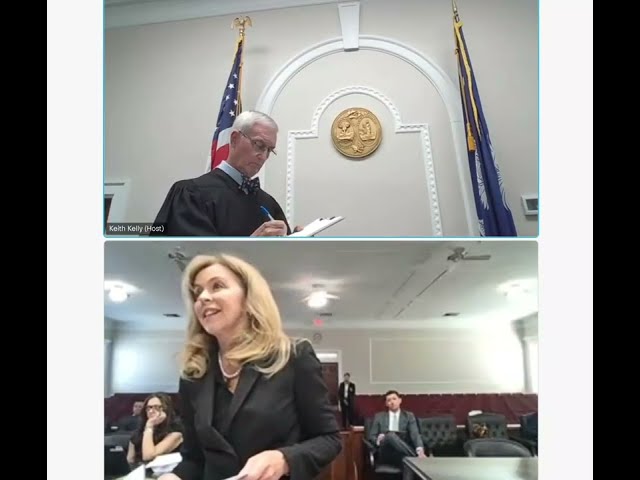
There was also a separate victory for prosecutors at the end of the hearing, when McCaslin granted their request to correct the record concerning an inaccurate statement about Murdaugh’s polygraph examination.
The hearing provided an unusually detailed look at the forensic evidence that could shape Murdaugh’s second murder trial, scheduled to begin April 5, 2027, in Sumter County.
It also exposed continuing disagreements over what evidence has been produced, what testing should be permitted, and how much access the defense should have to the scientific work underlying the State’s original prosecution.
Victory No. 1: Defense wins independent testing of DNA from Maggie’s fingernails and cellphone
The day’s most consequential ruling involved biological evidence that has become a central focus of Murdaugh’s defense.
Attorneys Phil Barber and Jim Griffin argued that previously collected DNA evidence could contain information about an unidentified male contributor, potentially providing new investigative leads.
The evidence involves three separate items:
-
Item 70: Fingernail clippings from Maggie Murdaugh’s left hand.
-
Item 71: Fingernail clippings from her right hand.
-
Item 25.1: Swabs collected from Maggie Murdaugh’s cellphone, which was recovered away from the murder scene.
The defense maintained that earlier testing had revealed indications of male genetic material that warranted additional examination.
Barber told the court that the defense initially concentrated on Maggie’s left-hand fingernails because the original South Carolina Law Enforcement Division report identified male DNA that could not be attributed to Murdaugh, according to the defense’s interpretation.
But after additional quantification work by Othram, a forensic laboratory in Texas, attorneys began examining the underlying data more closely.
That examination led to new questions about Maggie’s right-hand fingernails and her cellphone.
Barber argued that the quantity of male genetic material indicated in the right-hand sample was approximately twice that indicated in the left-hand sample.
He also maintained that the original laboratory report concerning Maggie’s cellphone did not adequately communicate the significance of the underlying genetic information.
The possibility that biological evidence from both hands and the cellphone might be connected became a central argument for further testing.
Barber told McCaslin that even establishing whether the same male contributor could be associated with multiple items would be highly material to the defense.
Why the cellphone DNA matters
The cellphone evidence carries particular significance because Maggie’s phone was recovered along a roadway, separate from the location where her body was discovered.
The defense has questioned who handled that phone and how it arrived at its recovery location.
Barber argued that identifying male DNA on the cellphone, and determining whether it could be associated with genetic material recovered from Maggie’s fingernails, might provide information about another person’s possible involvement.
But there is an important scientific distinction.
The presence of male DNA does not, by itself, establish when the material was deposited, who last handled the phone, or whether the contributor participated in the murders.
DNA can be transferred through direct contact, secondary transfer, or contamination. The defense acknowledged that the findings could ultimately prove unrelated to the killings.
Nevertheless, a genetic association between multiple items could give investigators a new lead that did not exist during the first trial.
That is precisely why the defense wanted the testing performed.
The dispute over Y-STR testing
Prosecutor Creighton Waters did not categorically oppose additional DNA testing.
Instead, he argued that the limited quantity of remaining evidence required a testing arrangement that would protect the interests of both sides.
The State proposed using an independent laboratory with results accessible to both prosecution and defense.
Waters emphasized that some of the remaining material could be consumed during testing, leaving no opportunity for another examination.
The defense rejected the State’s proposed arrangement.
Griffin argued that the evidence remaining after SLED’s original examination should be available for independent defense testing under South Carolina’s criminal discovery rules.
The defense sought Y-STR testing, which examines markers on the Y chromosome and can help identify male genetic contributions in samples containing large amounts of female DNA.
Unlike some other forms of genetic testing, Y-STR analysis generally cannot distinguish between men who share the same paternal lineage.
It may, however, help determine whether male DNA detected in separate samples is consistent with a shared paternal-line profile or excludes particular contributors.
Waters questioned whether the proposed testing would yield useful results and challenged some of the defense’s interpretations of the earlier laboratory findings.
He also disputed the suggestion that existing results conclusively excluded Murdaugh as a contributor across the relevant evidence.
That disagreement remains unresolved.
McCaslin sides with the defense
After hearing the arguments, McCaslin issued a clear ruling.
“I rule that the defendant is entitled to conduct an independent DNA test.”
The judge cited Rule 5 of the South Carolina Rules of Criminal Procedure and the defense’s right to examine evidence in the State’s possession.
She also recognized the potential significance of genetic material recovered from the victim’s fingernails and cellphone.
McCaslin declined to require the defense to conduct testing for the prosecution’s benefit or automatically provide the State with all results.
However, she made clear that applicable reciprocal discovery obligations would apply if the defense intended to introduce scientific reports or expert testimony at trial.
The judge also addressed the possibility that testing could consume the remaining material.
Murdaugh’s attorneys informed the court that their client would waive potential objections or future claims arising from the consumption of the samples through the authorized testing.
The defense estimated that the Y-STR testing could take approximately 90 days.
Why this is a major defense victory: Murdaugh’s attorneys now have the opportunity to pursue genetic evidence that could potentially identify or exclude contributors, compare samples recovered from different locations, and generate new investigative leads.
The State lost its effort to require a shared testing arrangement and automatic access to the defense’s results.
But the ruling does not establish that another killer’s DNA has been identified, nor does it establish that the biological evidence is connected to the murders.
Those questions depend on what the laboratory actually finds.
Victory No. 2: Judge orders State to release original FARO crime scene scan data
The second significant defense victory concerned the three-dimensional laser scanning technology used to document the Moselle crime scene.
FARO scanners capture detailed spatial measurements that can be used to create digital representations of physical locations.
In a homicide investigation, that information can help experts examine distances, the relative positions of objects, potential lines of sight, and the spatial relationships among important evidence.
Harpootlian argued that the defense needed access to the original scan data rather than relying exclusively on processed information previously supplied by SLED.
He acknowledged that the defense had not requested the underlying data during the first trial.
But he explained that defense experts now wanted to independently examine the measurements and verify the accuracy of the reconstruction.
Harpootlian was careful not to accuse investigators of intentionally manipulating the crime scene information.
His argument was that a digital reconstruction could be affected by the way the original data was processed, and the defense should have the opportunity to check it.
The dispute becomes heated
The disagreement quickly turned into another argument about the timing of discovery.
Harpootlian said defense attorneys had specifically requested the information in September and subsequently filed a motion after failing to receive it.
Waters countered that the State had already provided FARO-related materials for the first trial, including a version accessible through viewing software.
According to Waters, the new request concerned proprietary raw data requiring specialized software, rather than the material previously made available.
He maintained that prosecutors were willing to provide the additional information.
McCaslin appeared increasingly frustrated by the lawyers’ competing accusations.
When Harpootlian asked Waters to sit down while he finished speaking, the judge interrupted.
“Y’all need to stop this, OK?”
She reminded the attorneys that they were professionals appearing in a court of law.
“This is court. This isn’t a soundbite.”
The judge then moved the dispute toward a practical resolution.
State ordered to produce the information by Monday
McCaslin directed that the requested FARO information be provided to the defense by Monday, October 19.
Although prosecutors maintained they were not opposing production, the defense obtained the specific relief it had been seeking: access to the underlying data for independent examination.
Why this matters: The defense can now have its experts evaluate the original digital crime scene information instead of relying solely on SLED’s presentation.
That could allow attorneys to challenge the accuracy of particular measurements, reconstructions, or conclusions presented during the first trial.
It does not mean the original scans were inaccurate or manipulated. No such finding was made Friday.
But the order gives defense experts the opportunity to determine that for themselves.
For a prosecution built partly on reconstructing movements and events at Moselle, independent access to the underlying crime scene measurements is a potentially valuable preparation tool.
State victory: Judge rejects sweeping .300 Blackout ballistics investigation
The third major dispute centered on the .300 Blackout ammunition associated with Maggie Murdaugh’s killing.
During the first trial, the prosecution relied in part on forensic comparisons between cartridge cases recovered near Maggie’s body and other cartridge cases collected around the Murdaugh property.
The State argued that similarities in toolmarks supported a connection between the ammunition evidence at the murder scene and a firearm previously used at Moselle.
The defense has questioned both the reliability of that conclusion and the significance prosecutors placed on the ammunition type.
Harpootlian argued that .300 Blackout ammunition was not nearly as uncommon as the first jury might have been led to believe.
The defense sought additional information concerning other South Carolina investigations involving .300 Blackout ammunition, including records and cartridge cases that could potentially be examined by its own ballistics expert.
Harpootlian wanted to determine whether the ammunition evidence from Moselle could be associated with other firearms or criminal investigations.
The defense also questioned whether the State’s forensic comparisons had adequately distinguished between cartridge cases fired by the same weapon and those sharing more general characteristics.
Prosecutors argue the request is speculative
Waters opposed the expanded investigation.
He maintained that SLED had already performed relevant testing and that no ballistic matches had been identified connecting the evidence in the Murdaugh case to another weapon, crime, or investigation.
The State also argued that reviewing cartridge cases from numerous unrelated investigations would impose a substantial burden on SLED’s laboratory.
Some of those investigations remained open, creating additional concerns about access to evidence and investigative information.
McCaslin agreed with the prosecution.
In her ruling, she concluded that the defense had not established a sufficient factual basis for the broad discovery it requested.
The judge characterized the proposed connection to another unsolved crime as speculative and found that the defense had not satisfied the materiality requirement for compelling the additional review.
She also noted the substantial time, expense, and laboratory resources the requested work could require.
McCaslin declined to order SLED to undertake the broad manual review or compile the requested list of unrelated .300 Blackout cases.
She further concluded that questions about how common .300 Blackout ammunition was could be addressed through cross-examination and evidence presented at trial.
This was a clear victory for the State.
The defense did not receive permission to conduct the sweeping comparison of unrelated criminal investigations it wanted.
But the ballistics discussion did not end there.
The additional defense win: Raw .300 Blackout comparison data must be produced
After McCaslin rejected the broader ballistics request, Harpootlian raised a narrower issue.
If the State intended to rely on forensic comparisons linking cartridge cases found near Maggie’s body to cases recovered elsewhere on the Murdaugh property, shouldn’t the defense be able to independently examine the scientific basis for those conclusions?
Harpootlian argued that his expert should be able to review the same evidence and underlying comparison information used by SLED.
He challenged the reliability of cartridge-case toolmark comparisons, particularly the subjective component of visually examining microscopic markings.
The defense questioned whether the State’s conclusions were sufficiently supported by the available data.
Waters responded that the cartridge cases had been examined through established forensic procedures, including manual comparisons and use of a computerized ballistics system.
He maintained that the comparisons linking the crime scene cases to other cases from the property were conducted through manual examination, while the national ballistics database searches had produced no outside matches.
This distinction became important.
The defense was not simply asking whether another crime had produced a matching cartridge case.
It was questioning whether the State’s own comparisons within the Moselle evidence could withstand independent scrutiny.
McCaslin orders the raw data released
After further discussion, the judge directed prosecutors to provide the defense with the raw ballistic data already in their possession.
She then told Harpootlian that if his expert reviewed the information and determined additional access was necessary, he could return to the court.
That was a meaningful concession.
The defense did not obtain blanket permission to remove or independently test every cartridge case it requested.
Nor did the judge find that SLED’s original ballistic conclusions were wrong.
But she preserved a route for further examination and ordered production of existing underlying data.
The distinction is critical: The State won the fight over unrelated .300 Blackout investigations, but the defense won access to raw ballistic comparison information relevant to the evidence in its own case.
That gives Murdaugh’s attorneys another opportunity to examine the forensic foundation of the prosecution’s theory.
Why the cartridge cases could matter
The murder weapons have not been recovered.
As a result, cartridge-case comparisons have played an important role in the prosecution’s effort to connect the shootings to firearms associated with the Murdaugh property.
The State’s original case relied on evidence suggesting that the .300 Blackout cartridge cases recovered at the murder scene were consistent with other cases found at Moselle.
If defense experts identify significant limitations in those comparisons, attorneys could challenge the weight jurors should give that evidence.
Conversely, an independent examination could reinforce the State’s conclusions.
Friday’s ruling does not resolve that scientific dispute.
It allows the defense to investigate it further using the underlying information already available to prosecutors.
And that is why the additional ballistics order deserves to be counted separately from the State’s victory on the broader motion.
Other motions and discovery disputes addressed Friday
Although DNA, FARO scans, and ballistics dominated the hearing, McCaslin also addressed several additional disputes that could affect the retrial.
Maggie Murdaugh’s cellphone extraction files
The defense raised questions concerning access to cellphone extraction data.
Prosecutors indicated they were willing to provide the requested extraction information, while continuing to dispute suggestions that evidence had been improperly withheld.
The hearing did not establish that cellphone evidence had been intentionally concealed.
However, the dispute illustrated the continuing disagreements over whether each side possesses all the electronic evidence necessary for trial.
McCaslin emphasized that she expected discovery issues to be resolved well before April.
Allegations concerning the possible disposal of murder weapons
The defense also has sought information concerning allegations that a law enforcement official may have handled or possessed a suspected murder weapon after the killings.
The issue involves reporting about Yemassee Police Chief Greg Alexander and claims concerning the possible whereabouts or disposal of a weapon.
Those allegations have not been established as fact.
McCaslin did not order the State to accept the allegations as credible or conduct the sweeping inquiry suggested by the defense.
Instead, she reminded prosecutors of their obligation to disclose evidence if it becomes subject to Brady v. Maryland, which requires disclosure of material favorable evidence.
The issue therefore remains open to the extent additional qualifying evidence emerges.
DNA laboratory records and communications
The defense also sought assurances that prosecutors had produced the complete underlying DNA records, including electropherograms, laboratory worksheets, technical review records, and relevant communications.
Waters maintained that the State had already provided the required materials, subject to applicable privileges and continuing discovery obligations.
Barber explained that the defense wanted assurance that the production was complete, especially after its review of the underlying genetic data raised questions not apparent from the original laboratory reports.
McCaslin indicated that progress on the remaining production issues would be revisited at the November 13 hearing.
No finding of deliberate withholding was made.
A victory for prosecutors: Judge corrects Murdaugh polygraph claim
The hearing ended with a separate ruling that did not concern the physical evidence.
McCaslin granted a prosecution request to correct the court record regarding a statement Harpootlian made during an earlier pretrial conference.
The defense attorney had characterized Murdaugh as having passed a federal polygraph examination.
The judge clarified that the examination concerned whether Murdaugh had concealed financial assets, not whether he murdered Maggie and Paul.
According to the court’s correction, Murdaugh failed the examination concerning financial matters.
He had not undergone a polygraph examination concerning the murders.
McCaslin acknowledged receiving a letter from Harpootlian apologizing for the confusion.
But she also delivered a pointed warning.
“Candor with the court is not optional.”
The judge stressed that lawyers must make accurate representations and acknowledge when they do not know an answer.
She warned both sides against using the proceedings for publicity or courtroom theatrics.
The State therefore prevailed on its motion to correct the record.
That ruling should be distinguished from the three principal forensic disputes because it concerned the accuracy of an earlier statement, not the admissibility or independent examination of the murder evidence.

Judge warns both sides: The April 5 trial date is not moving
McCaslin repeatedly emphasized that she expects the retrial to begin April 5, 2027.
She expressed frustration with the volume of discovery disputes and the increasingly combative tone of the parties’ filings.
The judge warned attorneys against waiting until the last minute to raise missing evidence or request additional time.
She also suggested that failures to comply with discovery obligations could create evidentiary consequences.
At one point, she discouraged additional routine motions to compel and encouraged counsel to bring unresolved production problems directly to her attention.
Her message was unmistakable: Both sides must complete their preparations without turning every discovery disagreement into another courtroom battle.
The judge also confirmed that the retrial will take place in Sumter County, citing security, technology, infrastructure, and cost considerations.
The next pretrial hearing is scheduled for November 13 in Lexington County, with a subsequent conference planned for January 20 in Sumter.
The court also identified October 30 as the deadline for additional motions and November 6 for responses.
The scoreboard: Who won and who lost?
| Issue | Outcome |
|---|---|
| Independent DNA testing | Defense win — authorized to proceed |
| FARO crime scene data | Defense win — production ordered by Monday |
| Broad .300 Blackout investigation | State win — request denied |
| Existing raw ballistics data | Additional defense win — production ordered, further requests permitted |
| Polygraph record correction | State win — record corrected |
| Other discovery and weapons-related issues | Unresolved or subject to continuing obligations |
The defense therefore prevailed on two of the three principal forensic disputes and obtained an additional, narrower order involving ballistic data.
The State prevailed on the broader ballistics request and separately secured the polygraph correction.
That is a more accurate accounting than simply declaring one side the overall winner.
Crime and Cask analysis: Why Friday’s rulings matter
The most important development Friday was not the number of motions granted or denied.
It was the judge’s willingness to allow independent scrutiny of evidence that helped shape the first prosecution.
The defense now has an opportunity to pursue three distinct lines of forensic examination.
First, additional DNA testing could determine whether male genetic material recovered from Maggie’s fingernails and cellphone provides useful comparisons or investigative leads.
Second, the original FARO data will allow experts to examine the spatial information underlying the crime scene reconstruction.
Third, access to existing ballistic comparison data will give defense experts an opportunity to evaluate the State’s conclusions concerning the .300 Blackout cartridge cases.
Each line of examination carries uncertainty.
The DNA testing may produce no usable male profile. The FARO scans may confirm the accuracy of the original reconstruction. And the ballistic evidence may withstand independent examination.
But the defense no longer has to rely exclusively on the State’s existing interpretations of those materials.
That distinction matters in a retrial.
The unanswered question about Maggie’s phone
For Crime and Cask, the cellphone evidence remains one of the most significant unanswered questions in the investigation.
The first trial established that Maggie’s cellphone was recovered away from the murder scene.
The State presented digital evidence concerning the phone’s activity and movement.
But who physically handled the phone during the critical period surrounding the murders remains an important question.
The newly authorized testing could potentially provide information relevant to that question.
If a usable male DNA profile can be developed from the cellphone swabs, investigators may be able to compare it with the fingernail samples and appropriate reference profiles.
A consistent result across multiple items would warrant careful examination of possible sources and transfer mechanisms.
It would not automatically establish that the same person handled the phone during the murders.
But it could provide a basis for additional investigation.
Likewise, an exclusion of Murdaugh as a contributor to a particular DNA component would not, by itself, prove he never handled the phone.
The evidentiary significance would depend on the quality of the profile, its possible contributors, and the circumstances under which the DNA was deposited.
The important point is that those questions can now be investigated through additional testing.
What the State still has going for it
Friday’s rulings should not be mistaken for a judicial rejection of the prosecution’s murder case.
McCaslin did not exclude the State’s ballistic evidence.
She did not find that SLED mishandled DNA evidence.
She did not determine that another person committed the murders.
And she did not rule that the prosecution’s crime scene reconstruction was inaccurate.
The State successfully resisted a broad request to examine unrelated criminal investigations without a stronger factual showing.
That ruling demonstrates that McCaslin is prepared to impose limits on defense discovery when she believes the requests are insufficiently supported or unnecessarily burdensome.
Prosecutors also retain the opportunity to challenge any new forensic conclusions through their own experts, cross-examination, and applicable evidentiary rules.
What the defense gained
The defense obtained something potentially more valuable than an immediate courtroom argument: the ability to conduct additional scientific examination before jurors are selected.
Murdaugh’s attorneys can now investigate whether the existing evidence supports the State’s original conclusions or provides a reasonable basis for alternative interpretations.
The DNA ruling is especially important because the remaining biological material is limited, and the proposed testing may consume it.
McCaslin’s decision allows that examination to proceed rather than leaving the material untested while the parties continue arguing over who should receive the results.
The ballistics ruling was more limited, but it likewise recognizes that the defense should have access to the existing underlying information used in forensic comparisons.
And the FARO order gives defense experts the opportunity to verify digital measurements that may become important during the retrial.

The bottom line
Friday was a productive day for Alex Murdaugh’s defense team, particularly on the forensic issues that could affect how the murders are presented to a second jury.
The defense secured two major evidence-access victories and a narrower, additional ballistic-data order.
The State successfully blocked the requested examination of unrelated .300 Blackout investigations and obtained a correction of the court record concerning Murdaugh’s polygraph examination.
But no new scientific results were presented Friday establishing that someone else killed Maggie and Paul Murdaugh.
The real significance of the hearing will depend on what the independent experts discover.
If the DNA testing produces a usable profile, if the FARO data reveals a material discrepancy, or if independent ballistic review identifies a meaningful weakness in the State’s comparisons, the implications could extend well beyond Friday’s discovery disputes.
If those examinations produce nothing new, the prosecution’s original forensic interpretations may remain substantially intact.
For now, McCaslin has opened the door to further independent testing while drawing a clear boundary against speculative, wide-ranging discovery.
The defense won the right to look more closely. What it finds could help determine the direction of the April 2027 retrial.
Crime and Cask News Network — Independent Investigative Journalism
Reporting note: This article is based on the October 16 hearing transcription, which includes live commentary and automated transcription errors. The ruling descriptions should be checked against any subsequent written orders.
About the Author